_Horizontal%20%20White-%20Logo%20and%20Text%20copy.png)
_Horizontal%20-%20Logo%20and%20Text.png)
Local Economies Need Infrastructure, Not More Apps
Local Economies Need Infrastructure, Not More Apps
Civilization is created and sustained by infrastructure.
Roads, wells, town squares, markets, and gathering places were never afterthoughts. They were the physical backbone that allowed communities to form, trade, share knowledge, and endure. The same principle holds true in the digital age. Small towns, especially those with significant tourism, do not need yet another app. They need proper digital infrastructure, a coherent, community-owned system that serves as their modern front door and operating system.
Most high-tourism towns today are drowning in apps. There is an app for lodging, another for tours, another for restaurant reservations, another for events, and yet another for parking or trail maps. Each one extracts value. Each one fragments the visitor experience. And each one treats the town as little more than a collection of listings to be monetized.
This is not progress. It is digital sprawl.
The Difference Between Apps and Infrastructure
An app is a product. It is designed to maximize engagement or transactions for its owners, who usually have no long-term stake in the town’s health.
Infrastructure is different. It is shared, enduring, and oriented toward the common good. It exists to make the entire ecosystem function more effectively while preserving the unique character of the place it serves.
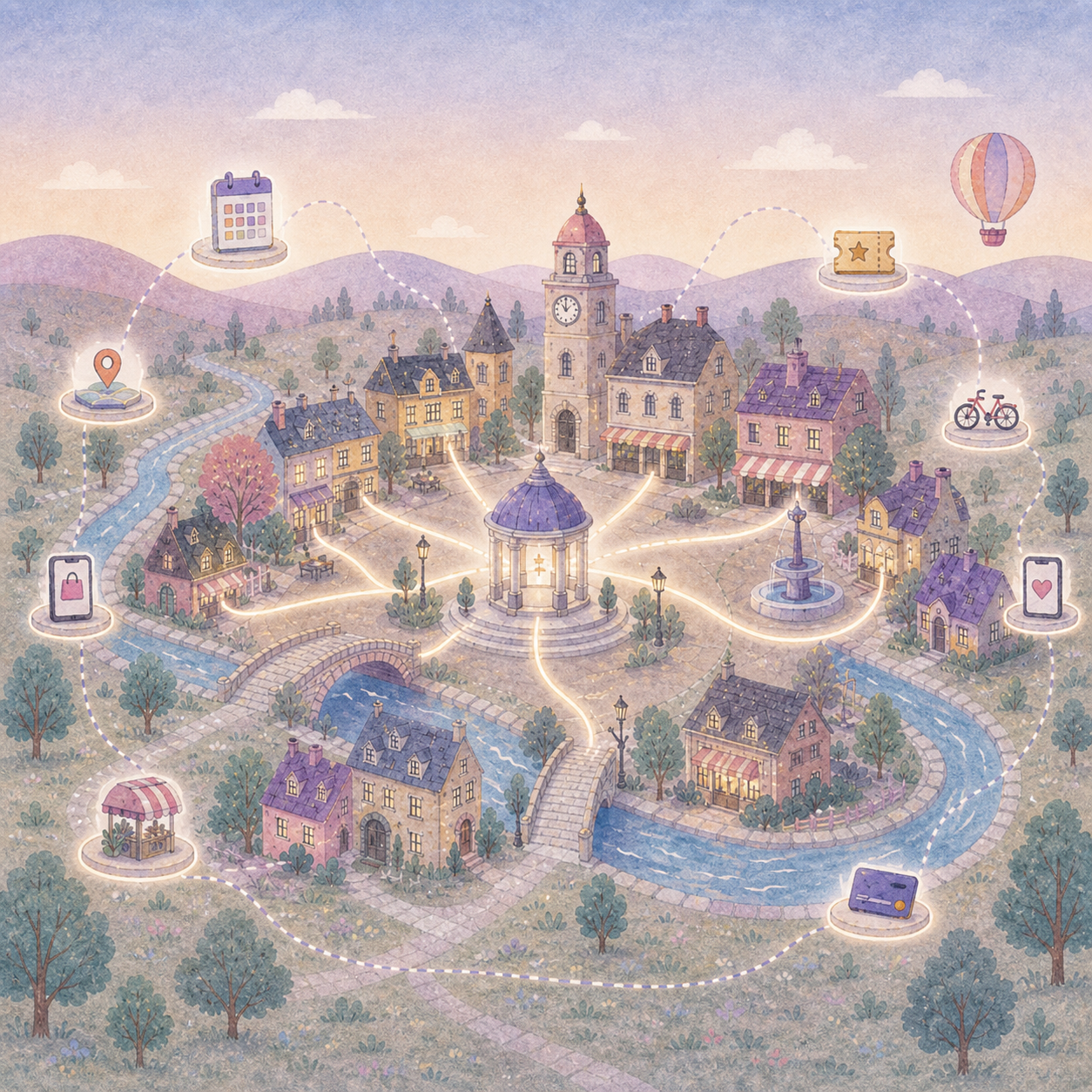
A true digital front door is infrastructure. It is not another tourist brochure or a collection of scattered booking links. It is the town’s unified digital layer, a single, branded platform that connects discovery, booking, payments, operations, and community benefit in one coherent system.
It is built for the town, owned in spirit by the town, and designed to strengthen the town rather than extract from it.
What Proper Digital Infrastructure Enables
When a town has real digital infrastructure, several powerful things happen at once.
Visitors experience the town as a place rather than a checklist. They discover authentic experiences more easily, move more fluidly between businesses, and spend more locally because the path of least resistance leads them to local merchants instead of distant platforms.
Local businesses gain visibility and tools without being forced to compete on a dozen different fragmented channels. They can focus on hospitality and quality instead of managing yet another login and marketing dashboard.
The chamber and town government finally gain meaningful insight and coordination. They see real data about visitor behavior. They can plan events and infrastructure improvements with better information. And they receive a direct revenue share: Xenia reinvests 10% of platform earnings directly back into the community.
Most importantly, the town regains agency over its own story and its own economy. It decides how it wants to present itself to the world instead of allowing distant algorithms to define it.
Towns as the Bedrock of Civilization
Towns are the true birthplace of civilization. They are the human-scale places where shared identity first takes root, where commerce becomes personal exchange, where culture is lived in daily rhythms rather than performed, and where people learn the delicate art of living together with mutual respect and care.
When we allow our digital infrastructure to be owned by platforms that see towns as inventory, we erode that foundation. We turn unique places into interchangeable destinations. We allow the subtle, human connections that make a town feel like home to be replaced by algorithmic efficiency.
A community-owned digital front door reverses this trend. It reaffirms that towns are not products to be optimized. They are living ecosystems worthy of thoughtful infrastructure.
It creates a new center of gravity for cooperation. The chamber, local government, businesses, and residents begin working toward the same goal: creating an exceptional experience for visitors while protecting and strengthening what makes the town special. This shared purpose is rare and powerful. It moves the conversation from competition over scarce attention to collective stewardship of something valuable.
The Choice Before Us
Small tourist towns now face a quiet but consequential decision.
They can continue adding more apps — more fragmentation, more extraction, more loss of control. Or they can invest in proper digital infrastructure: a unified platform that belongs to the community, serves its people, and helps carry its unique character into the future.
The towns that choose the latter are not simply modernizing. They are protecting one of the oldest and most essential building blocks of civilization, the town itself, and giving it the tools it needs to thrive in a digital world.
Local economies don’t need more apps.
They need infrastructure.
And the best infrastructure is the kind the community actually owns and shapes for itself.